DIGITAL PREVENTIVE HEALTH
Risk detection is only the beginning.
From Risk to Action.
e-SIGRA is a digital preventive-health platform that helps community health workers, cadres and primary-care teams identify and follow up risk among pregnant women. It connects screening, prioritised alerts, validation and structured follow-up into one accountable workflow.
Field-tested since 2022 — now piloting in Medan, North Sumatra to measure how completely detected risk turns into follow-up.
THE RISK-TO-ACTION WORKFLOW
A connected workflow, not a single alert — each stage hands off to the next until follow-up is complete.
A risk signal means little if action comes too late.
Screening tools are good at finding risk. What happens after a case is flagged is where preventive health often loses its momentum. Without a shared record of who was flagged and what happened next, a case can quietly go unfollowed — not because no one cared, but because no one owned it. e-SIGRA focuses on that operational gap between detection and follow-through.
“The gap is not only detection. It is follow-through.”
WHAT IS e-SIGRA?
A closed-loop preventive health platform.
Screening
Structured digital risk screening, built on rules- and scoring-based logic.
Prioritisation
Risk signals are surfaced for health-worker review, in order of urgency.
Validation
Health workers review each case and retain final clinical decision-making authority.
Follow-up
Validated cases move into structured action and monitoring through to completion.
HOW IT WORKS
Six stages, one accountable loop.
Detect
A structured digital screening captures risk indicators using a rules- and scoring-based logic, field-tested through community midwifery practice.
Understand
Screening responses are organised into a clear risk profile, so a health worker can see what was flagged and why, without interpretation guesswork.
Alert
Risk signals are prioritised and surfaced to the relevant health worker, with critical indicators kept visible rather than diluted by additive scoring.
Validate
A health worker reviews the flagged case and makes the clinical call. e-SIGRA supports this review — it does not decide on the worker's behalf.
Act
Validated cases move into a structured follow-up pathway, so a detected risk is connected to a defined next step rather than left open.
Monitor
Follow-up status is tracked through to completion, giving a visible record of whether risk-to-action actually closed the loop.
Designed for the field, not just the dashboard.
Deteksi Dini
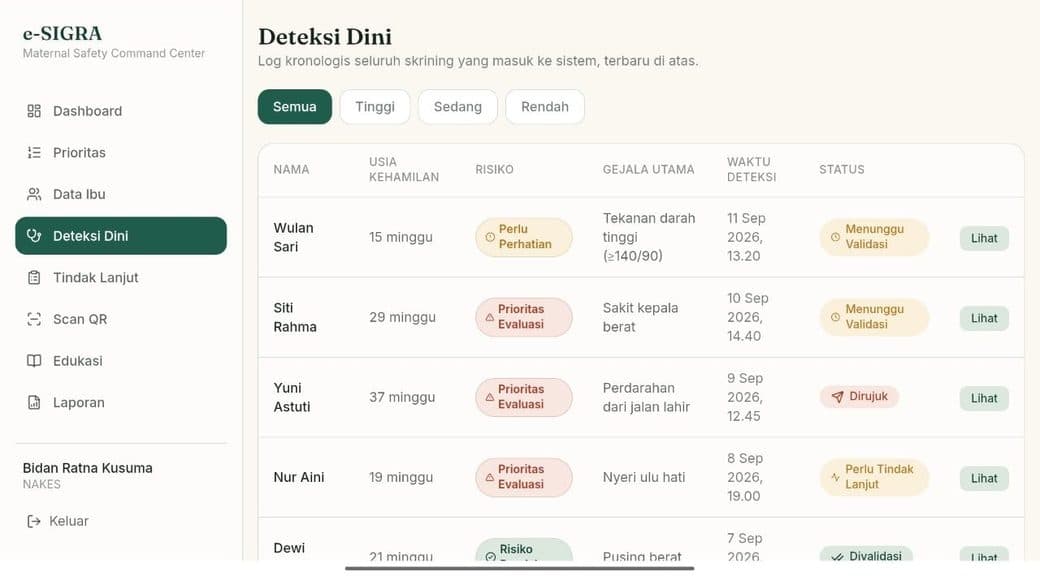
Digital Screening
A guided, structured intake for capturing risk indicators in the field, using the platform's rules- and scoring-based screening logic.
Dashboard
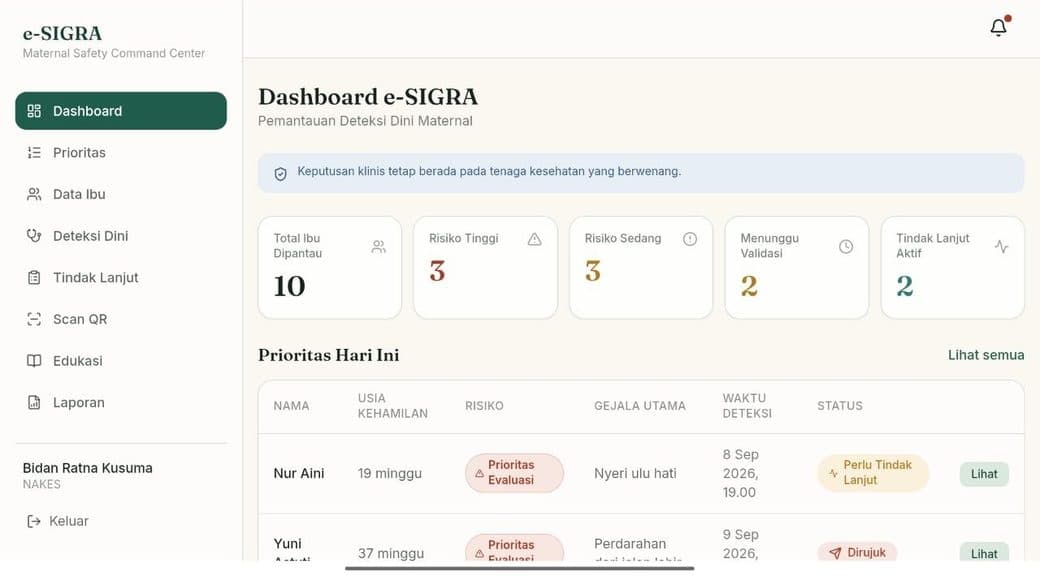
Prioritised Risk Dashboard
Flagged cases ordered by urgency, so a health worker's attention goes to the signals that need it first.
This reflects e-SIGRA's safety model: risk levels are surfaced for health-worker review and action, not presented as an autonomous diagnosis.
Laporan
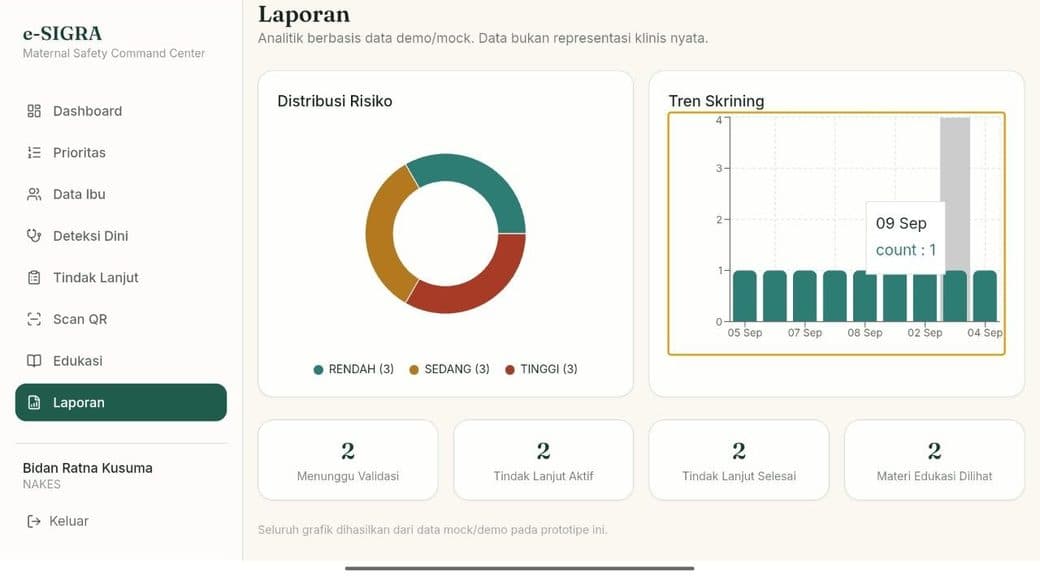
Reporting & Follow-up Tracking
A shared view of validated cases and follow-up status, from review through to completed follow-up.
Actual screenshots from the e-SIGRA prototype. Names and figures shown are demo data, not real patients.
Built to assist care, not replace clinical judgement.
Clinical Safety
Critical indicators are not diluted by additive scoring — a single serious flag is treated as serious.
Human Validation
Health workers retain final clinical decision-making authority at every step of the workflow.
Security
Role-based access control, access-control hardening and QR-code revocation are part of the platform's security approach.
EVIDENCE
Built from the field. Evolving through evidence.
Origin
2022
Prototype
2025–2026
Software testing
43 automated tests
Security
IDOR / RBAC / QR revocation
Clinical safety
Critical indicator override
Pilot
FGC 2.0 — Medan
Evaluation
Baseline → Midline → Endline
- 2022Field origin
Manual screening tool
Developed as a professional midwifery final project under academic and clinical supervision, with risk scoring informed by the Poedji Rochjati maternal risk-screening framework.
- 2025Development
Digital prototype
The manual tool's screening logic was digitised into a functional prototype.
- 2026Hardening
Security & clinical-safety hardening
IDOR fix, role-based access control, critical-indicator override, and QR-code revocation.
- 2026–2027Pilot
Urban pilot in Medan
FGC 2.0 pilot testing the connected screening-to-follow-up workflow in the field.
- FutureRoadmap
Evidence-led scale
Staged adoption contingent on validated pilot evidence.
Development / readiness evidence
43
Automated tests
0
TypeScript / lint errors
Software-readiness indicators, not clinical outcome evidence.
PILOT
e-SIGRA Pilot — Medan
0+
Pilot participants target
0+
Health workers & cadres target
0months
Months, pilot duration
Pilot targets — not achieved results.
Why Medan
Medan, North Sumatra is the site for e-SIGRA's first field pilot — an urban primary-care setting where the full screening-to-follow-up workflow can be tested against real day-to-day conditions before any wider rollout decision.
Pilot objective
Test whether a connected screening-to-follow-up workflow can shorten the time between risk detection and appropriate action, and improve how completely risks are followed through.
Who
500+ pregnant participants and 30+ health workers & community cadres — pilot targets, not enrolled numbers.
What we measure
The pilot will track whether identified risks move through review, validation and follow-up, using Risk-to-Action Completion Rate as the primary process metric. Full measurement framework.
Timeline
6 months, run in six phases: Baseline → System Adaptation → Clinical Validation → Capacity Building → Field Deployment → Evaluation.
Expected deliverables
A measured Risk-to-Action Completion Rate baseline, documented time-to-review and time-to-follow-up, validated health-worker acceptance of the workflow, and an evidence base for the scale-up decision.
Scale-up pathway
Contingent on validated pilot evidence: Individual → Community → Healthcare Facility → Puskesmas Network → Local Government → Other Cities.
We measure before we claim.
Hero metric
Risk-to-Action Completion Rate
Secondary metrics
Current metrics are designed to test workflow performance and readiness. Future economic evaluation may examine potential cost avoidance.
Better risk management starts upstream.
Future evaluation opportunity
Future work may evaluate the relationship between improved risk-to-action performance, appropriate referral pathways, healthcare utilisation, and potential cost avoidance.
ROADMAP
Designed to scale in stages.
Year 1
Pilot
Validation → Evidence. Running FGC 2.0 in Medan and completing baseline–midline–endline evaluation.
Year 2
Adoption
Target: Puskesmas and Dinas Kesehatan partnerships (not yet initiated), building on pilot evidence.
Year 3
Scale
Replication and sustainable B2G/B2B pathways in additional locations.
Proposed adoption ladder
Interoperability with relevant health-system infrastructure (such as SATUSEHAT or Puskesmas information systems) is a future scale-up consideration; the current pilot focuses on validating the risk-to-action workflow itself.
Clinical insight meets digital execution.

Anggi Fitriyani
Bdn., S.Tr.Keb
Founder / Project Lead
e-SIGRA began as Anggi's professional midwifery final project in 2022, developed under academic and clinical supervision. Its screening indicators, risk scoring, thresholds and workflow were reviewed during development, with the scoring approach informed by the Poedji Rochjati maternal risk-screening framework.
- Clinical oversight
- Screening-content review
- Pilot accountability
Erina Eka Hatini
S.S.T., M.P.H.
Academic & Clinical Supervision
Supervised e-SIGRA's development as Anggi's final-project advisor, reviewing its screening indicators, scoring and thresholds. Formally listed as a co-creator in the e-SIGRA copyright registration.
- Academic supervision (final project)
- Screening-indicator and scoring review
Community
- Community engagement
- Cadre coordination
Technology
- Platform engineering
- Security
- Data infrastructure
e-SIGRA is registered as a computer program copyright with Indonesia’s copyright office (registration no. 000920504), listing Anggi Fitriyani and Erina Eka Hatini, S.S.T., M.P.H. as creators. Registration establishes authorship, not clinical validation.
Build the next phase with us.
Whether you run a facility, shape system-level policy, or bring technology and research capacity — there’s a role in e-SIGRA’s next phase.
Prefer email directly? hello@esigra.health